
MLZ-Advanced
An end-to-end platform for land and property sales: public lead capture, a map-based customer journey, and a large internal console for inventory, sales, payments, and approvals.
Next.js 16
React 19
TypeScript
Prisma + MongoDB
Mapbox GL
SCSS
Recharts
Overview
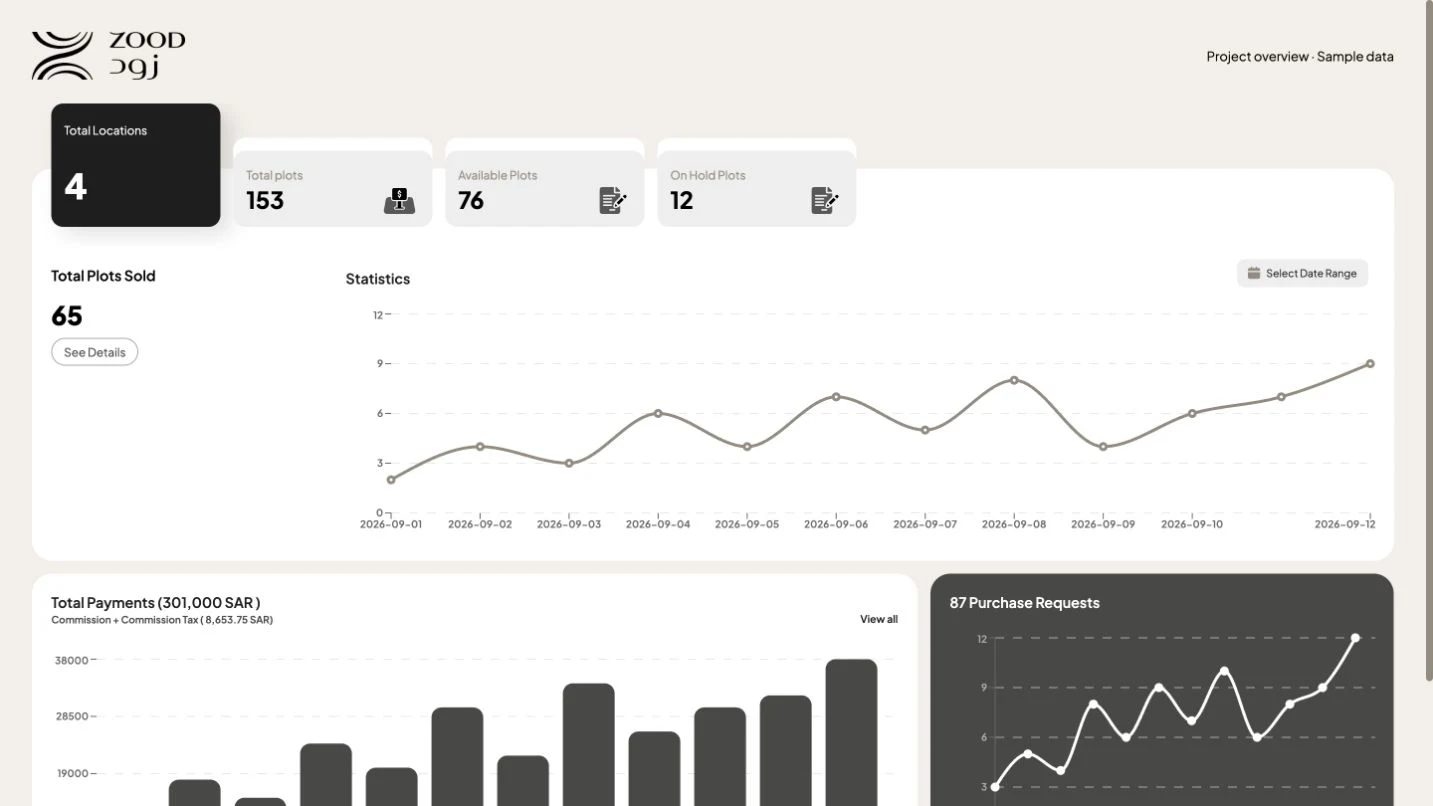
MLZ-Advanced is the operations platform behind a real estate sales business. One side faces the public and customers: landing pages, a map-based browser for projects and plots, and a purchase-interest flow with phone verification. The other side is a deep internal console where staff manage the entire sales operation, including inventory, customers, purchase requests, payments, approvals, reporting, and communication. It's a long-running, large-scale application that ships as a progressive web app and runs bilingually in Arabic and English.
The Problem
Land and plot sales involve a lot of state that's hard to keep straight. Each plot carries pricing, dimensions, orientation, ownership, utilities, and a status that changes as it moves toward a sale. Customers progress from lead to opportunity to buyer, payments arrive in different structures and need approval, and many actions need sign-off, including resales, cancellations, and permission changes. Doing this across spreadsheets and disconnected tools doesn't scale. The business needed one system that handled the public-facing journey and the internal machinery, with the audit trail and approvals a real estate operation depends on.
My Role & Approach
This is a large team project that has grown over a long period, and I worked as a front-end engineer within it. The codebase is organised so that very different audiences, the public, customers, and internal staff, share one deployment while staying cleanly separated by route group and permission. Much of my front-end work centred on the interaction-heavy surfaces: maps, bulk editors, charts, and the dense detail views where staff actually do their jobs, built as client components on top of server-rendered, access-controlled data.
Tech Stack
Key Features
Gallery
Challenges & Solutions
The platform serves three audiences from one application, which is easy to get wrong. The structure leans on Next.js route groups to keep the public site, the customer journey, and the internal dashboard isolated by function and permission while sharing a single deployment. The dashboard layout itself loads the current user, derives their department's modules, and filters navigation accordingly.
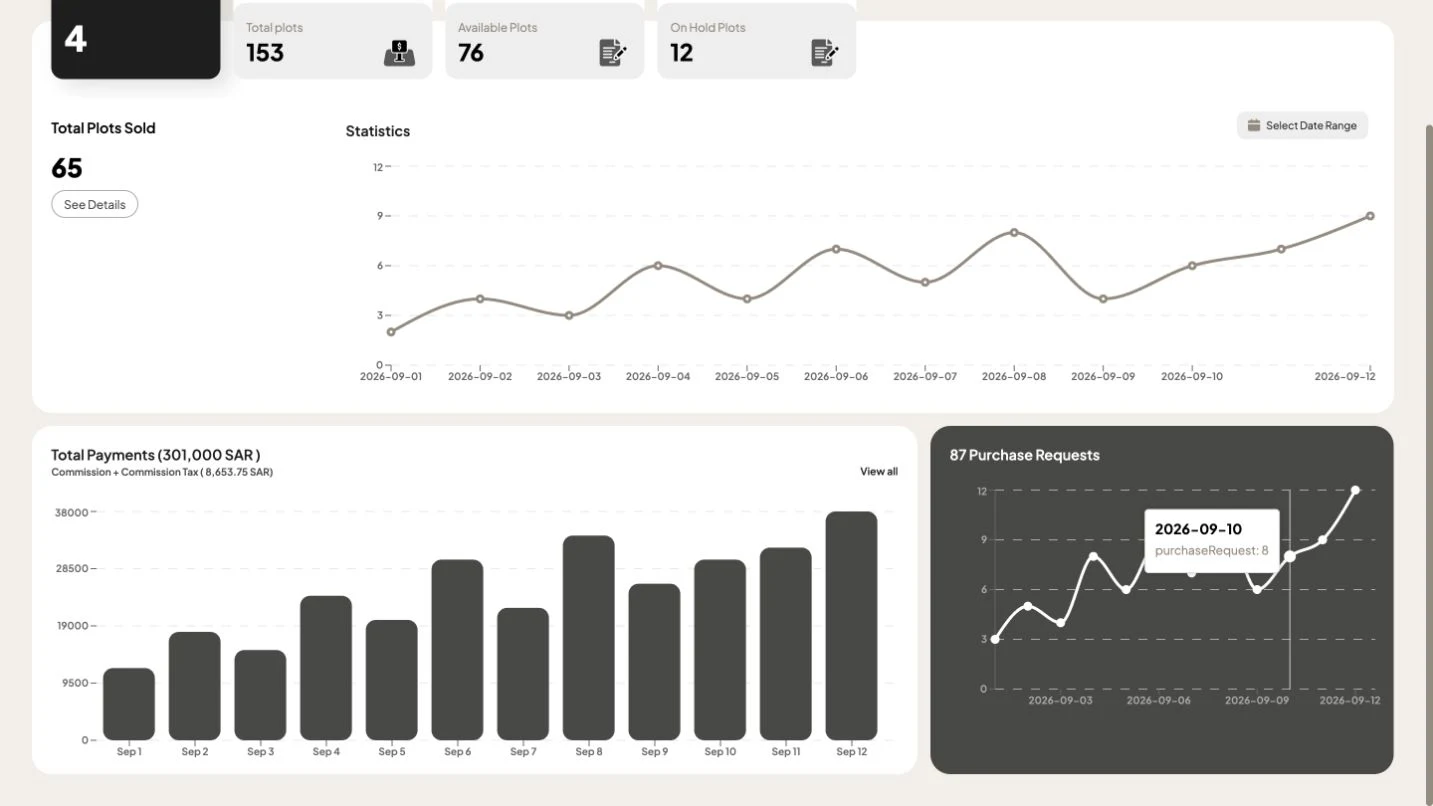
Performance under real data volume was the other constant pressure. Land inventory means large lists, heavy maps, and data-dense detail pages, so the app keeps data fetching and authorisation on the server and reserves client components for the genuinely interactive parts: maps, bulk grid editors, charts, and modals. Virtualised lists keep long tables responsive, and map data goes through GeoJSON conversion so plots render as real spatial objects rather than static images.
Outcome
MLZ-Advanced is a comprehensive system that takes a real estate business from a public visitor all the way through to a completed, approved, paid sale, with the inventory detail, CRM depth, and approval trails that operation requires. Its longevity and scale, a multi-year, high-activity codebase, point to a platform that has genuinely run a business rather than a prototype.
Have a similar product problem?
Share the current product, the outcome you need, and the constraints already in the way. I will use that to define a sensible first milestone.
Hire a full stack developer